
EDITORS NOTE
I first met Lesley Bodzy at Future Fair this spring. I stood before one of her abstract paintings for a while, reveling in its pure aesthetic pleasure. In that moment, the painting read as Frankenthaler’s dreamscapes rendered in something softer, and I later learned it has a sibling logic to everything else she makes. Bodzy was impeccably dressed and carried herself with a warm, confident elegance. We fell into talking, and within minutes had covered abstract expressionism, beauty, and what society asks of women across generations.
An afternoon in her Chelsea studio followed. I then saw the continuity — the woman, the room, and the works all doing the same thing — seemingly on the surface but also beyond. This is an attempt to read that.
— Lyndsey
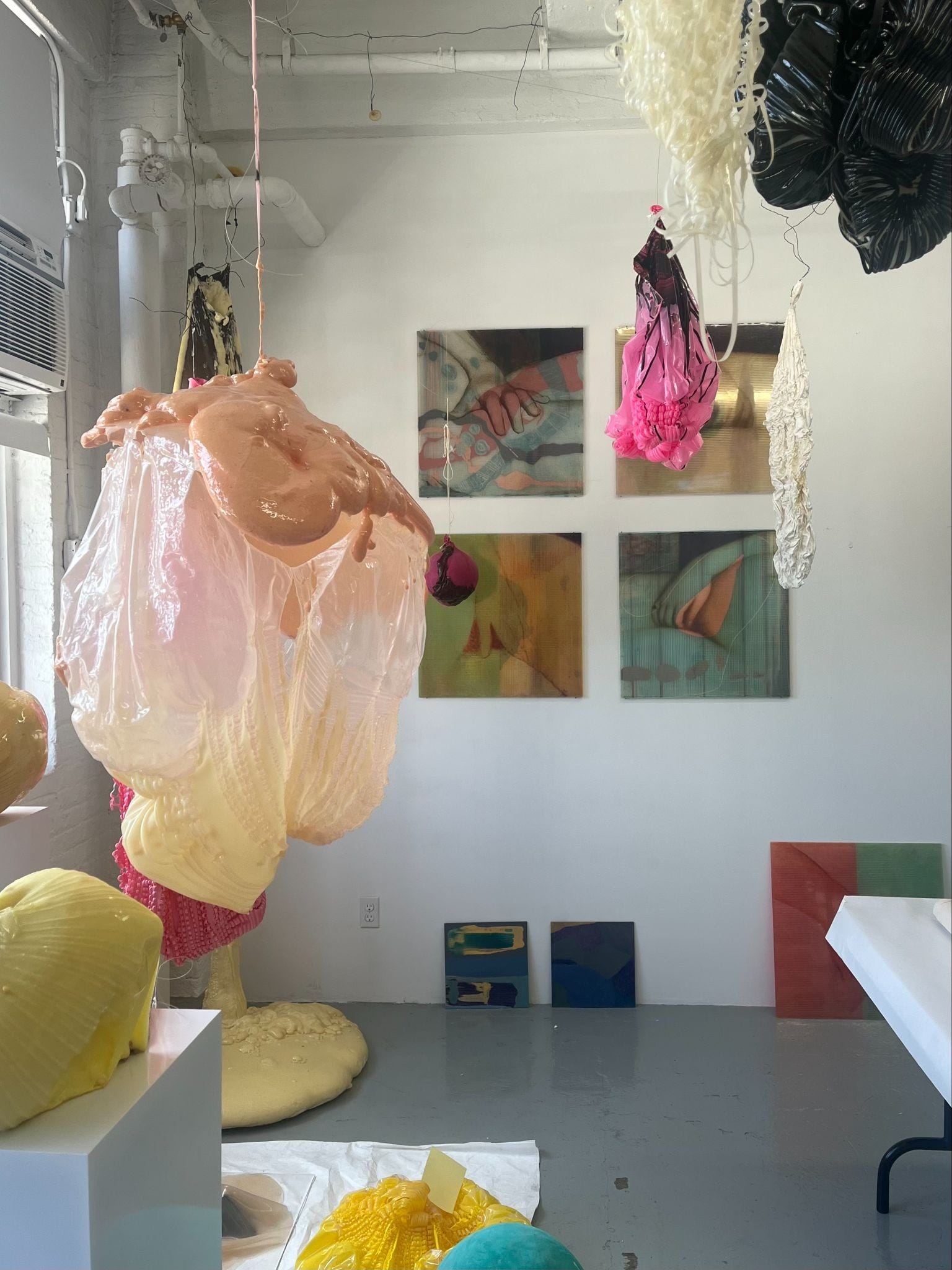
A Thursday afternoon in Chelsea, late light filtering through window glass. Bodzy’s studio doubles as a showroom, and the work is everywhere at once — a black mass glossy as patent leather overhead, a gold drape pinned flat to the wall, pastel paintings proposed alongside the baseboard, foam forms pooled on the floor. The largest piece hangs at eye level: a clear, inflated skin with apricot resin poured over the top, caught mid-run down the sides.
Bodzy moves through the room picking things up, turning them over, handing them to me: a sheet of patterned paper a friend sent over that she’s itching to paint on, a small aqua balloon she made six years ago, a gold fold of something that catches the light and holds it.
She stops at a balloon that didn’t behave. She had filled it with liquid foam - the kind that expands and sets - and somewhere in the chemistry the foam pushed back out through the skin and spilled down one side, hardening mid-escape into a frozen rivulet. A studio assistant, unhappy with the color, painted over it. Bodzy kept it exactly as the accident left it.
“You never know what’s going to happen.”
She says, with the pleasure of someone for whom that’s the entire appeal. It is, in miniature, how she works: set a material free, refuse to fully govern it, and find the form and beauty in what it decides to do.
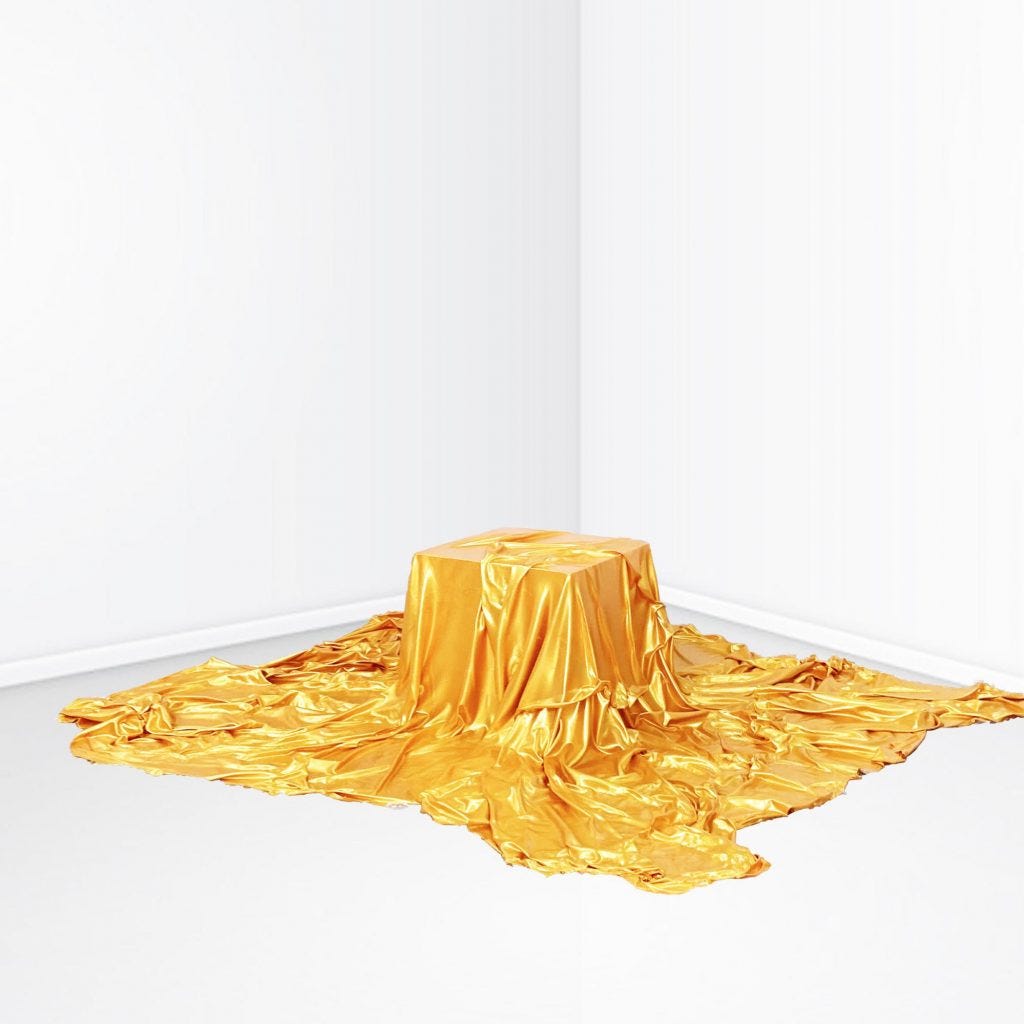
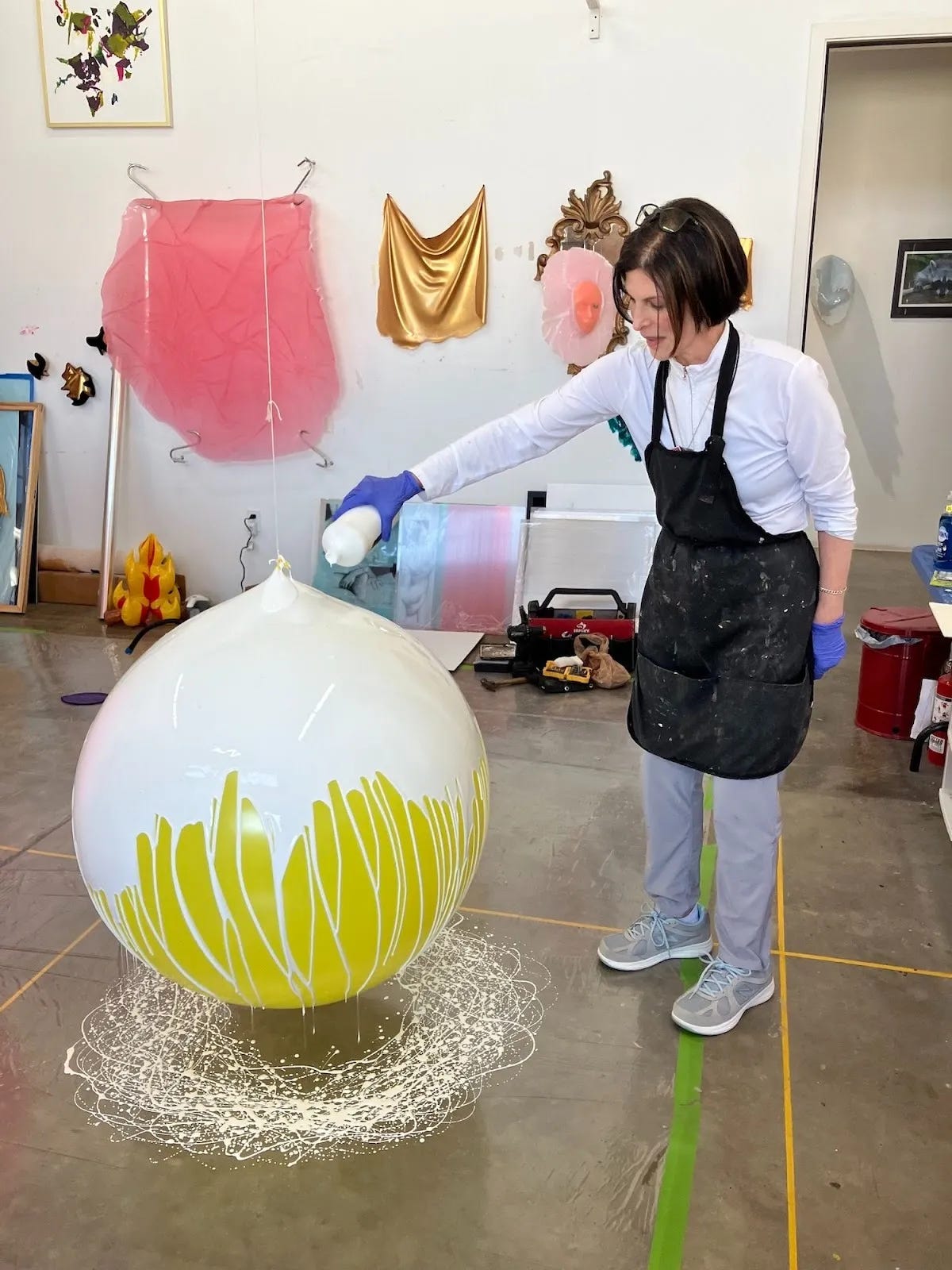
Lesley Bodzy works in skins. She pours acrylic onto the floor and lets it pool, then lifts the sheet of dried paint and drapes it over a form, where it falls in folds like satin or shed skin. She coats inflated balloons in resin and glue, lets them set, then pops them so the taut thing slackens into something softer and stranger. Membranes, shrouds, veils. The surface is both how Bodzy makes and what she is making about.
The process is material-first, close to improvisational. She works from impulse rather than toward a planned image - a kind of trance-like listening, she said, each material handing her to the next. She was thinking about Eva Hesse, one of the first to work in latex, about Hesse’s forms inflated, wrapped, then deflated. Bodzy blew up a small balloon. Someone asked why she didn’t make it bigger. She then made it much bigger.
Her two principal bodies of work sit at opposite ends of how much she controls. The poured gold took months to master — learning to mix and manipulate the acrylic until it could be lifted and sculpted without tearing, patient and exacting. The resin-on-balloon is nearly pure chance. The discipline behind both is the same: trust the process, she says, and know when to stop.
A critique that has trailed Bodzy for years is that her work is too decorative. Too pleasing. The kind of thing the eye slides off on its way to something more serious. She declines the premise entirely.
“I refuse to make something that I think is ugly.”
She means it as a working principle. After every piece she asks one question first — is this pleasing to me? This insistence is a mechanism beyond vanity. Beauty is what brings one close enough to stay. And once in proximity, the surface reveals something deeper.
The gold works make the argument most directly. Draped sheets of poured, gilded acrylic, hung so they hold the memory of a body that isn’t there — Bodzy frames them around concealment. The gold, she says, is the shiny veneer each of us presents to the world: the role we’re taught as children to perform for our parents and for society, the composed exterior we maintain while the real feeling stays behind it, in the quiet of our own reflection. She made them while thinking about how women, herself included, can feel they must stay silent, or hidden.
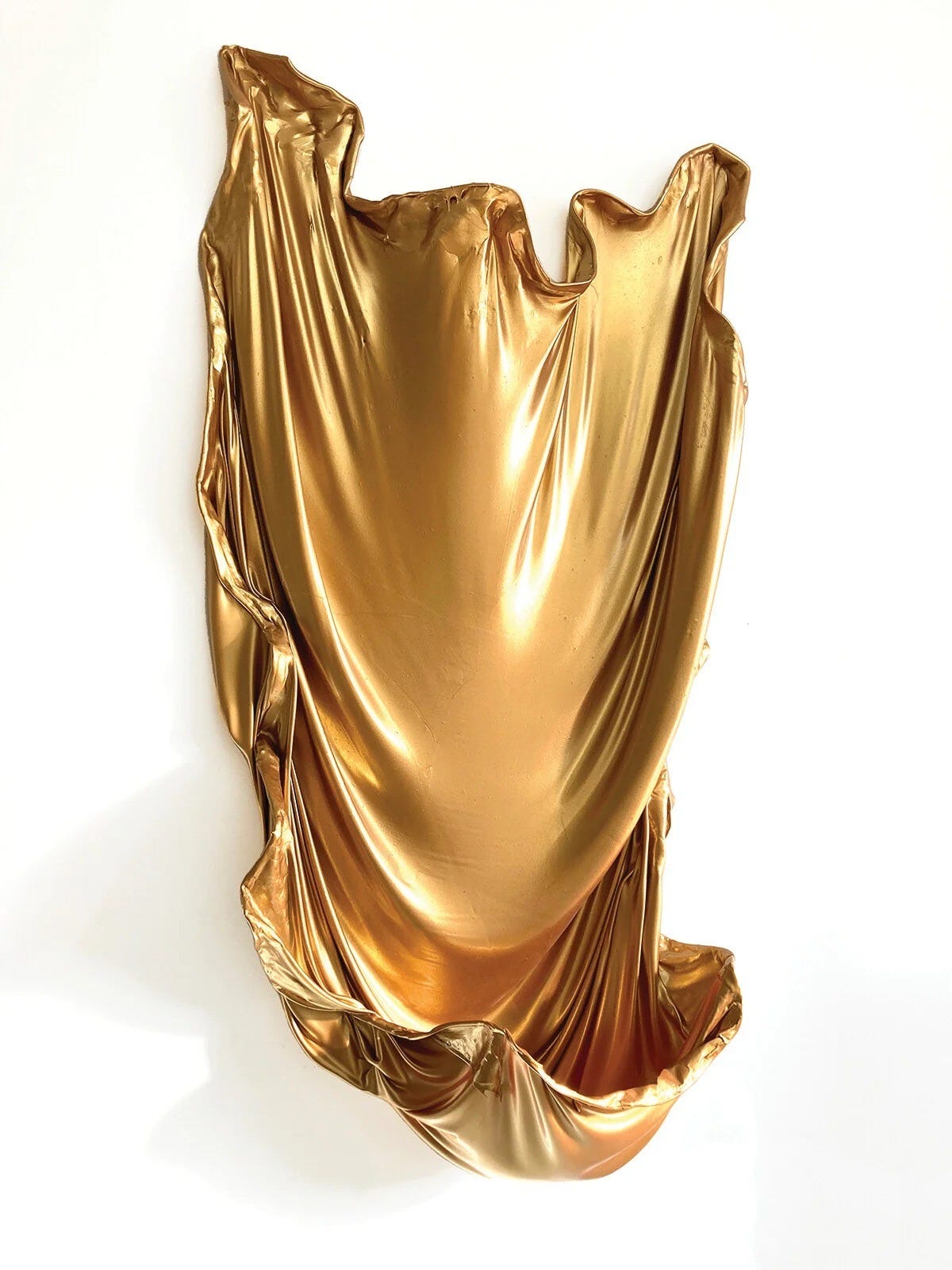
It would be easy to read this as a protest against the surface — strip the veneer, free the self — but Bodzy doesn’t go there. She isn’t against the construct. Her own identity, she’ll say, is partly one: there’s the interior person and there’s the exterior she has spent years building, and building it — a personal style, a way of meeting the world — is itself interior work. The surface is where the hiding and the revealing happen at once.
I felt this most when Bodzy talks about her own politics. Critics keep calling Bodzy’s feminism quiet — present, never confrontational — and I wanted to know whether the restraint was strategy or temperament. Neither, not quite. It was about her moment, she said, her history, her own feminism: she likes being a feminist, but fighting for it from inside the system. The composed surface of the gold works isn’t capitulation. It’s the terms she’s chosen to work on — legible, admitted into the room, saying what it came to say once it’s there.
If the gold works are the surface intact, the balloons are the surface giving way. The idea arrived only after the making. Bodzy was trying at one point to keep the balloons permanently inflated, perhaps by casting them in glass. She then understood why she couldn’t, and why she shouldn’t want to. Like the balloons, she realized, no body stays firm forever. Deflation comes for everyone. The balloon works belong to a series she frames as levity and depth: levity for human and lightness, depth for the subject underneath, which is aging and time.
Her gallerist noticed the thing Bodzy now repeats like a thesis — that the most beautiful of the balloons, the brightest in color, and the ones most fully collapsed. The slackened forms are not the failures of the lovely thing but the lovely thing itself, owning what time did to it. Each unique and irreparable.
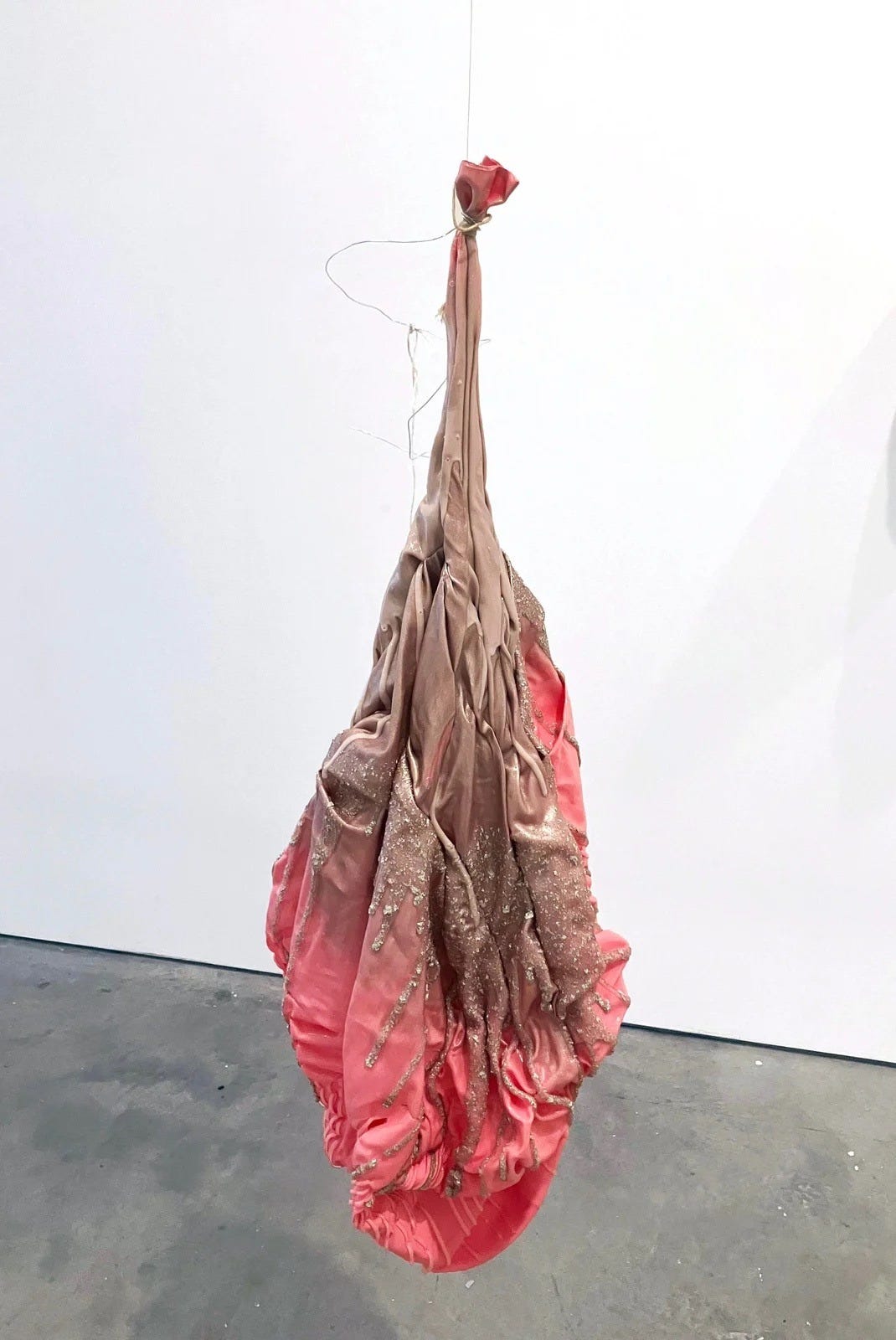
This is the register where she is at her deepest. She is drawn, she says, to the threshold where the beautiful begins to fray and the grotesque turns oddly seductive, to forms that look exquisite at a distance then reveal their fractures up close. She reaches for Nietzsche, the abyss that gazes back: to really face something raw is not a mere reflection but an implication, asking one to sit with what won’t resolve.
“I want to dislodge.”
She’s careful to say she isn’t after shock. It’s drawing one in with beauty then opening a door inward. Attraction and unease on the same surface, felt at two distances.
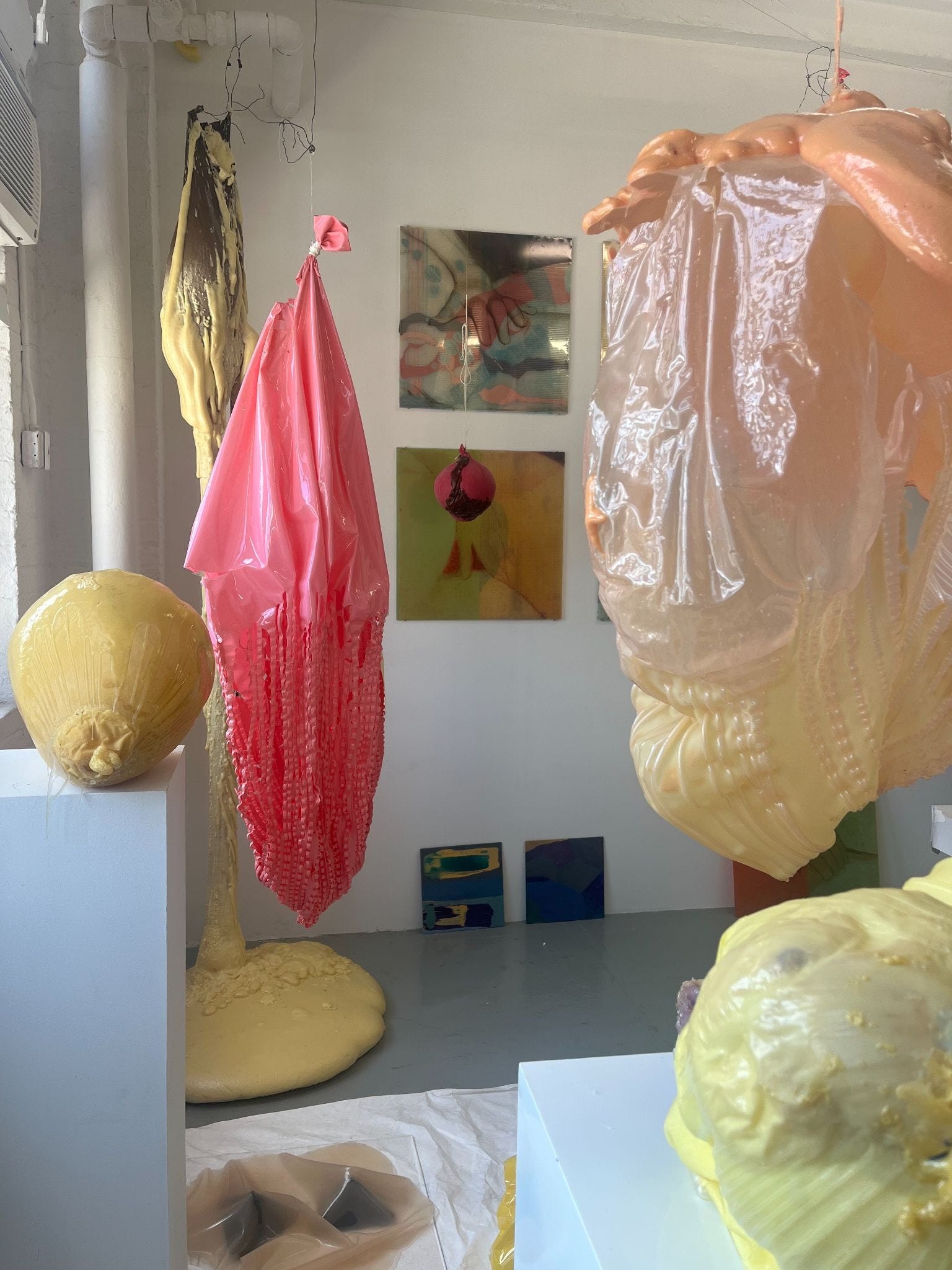
I had assumed, before meeting her, that the lawyer Bodzy once was — she practiced before turning to art full-time — might show up in her work; that a career built on revealing and withholding might shape how she handles concealment. She told me it’s the opposite. Law was the logical, organized system. Art is where she gets to be spontaneous, to play, to let the material misbehave. The surface in her work is where Bodzy goes to stop controlling, which is its own honesty about what the composed exterior is for: to build with so much care that somewhere, behind it, one can finally let go.
Spend the afternoon and the categories quit holding. Fashion sits on the same continuum for Bodzy — not a lesser cousin to the art but the same instinct in another medium. Putting something beautiful on, building a look to match a mood, is a way of handling time, the same way art is. She doesn’t feel right, she says, when she isn’t making something. Dressing, pouring, popping, all as one practice. The exterior is interior work, all the way down.
This continuity is what Bodzy’s prior interviews — polished into their own kind of gold surface — couldn’t quite show me. I had to be in the room. Here, Bodzy isn’t hiding depth behind a beautiful surface, neither is she apologizing for the surface. The distinction collapses. The decoration is the argument. The veneer is the self-portrait. The lovely thing and the cracked thing as one subject — and she wants you near enough to feel both.
Close enough that the gold holds. Then closer, until it doesn’t.